
Why KYC exists (and why it concerns everyone)
KYC – short for “Know Your Customer” – refers to the identity checks an operator performs to confirm you really are the person you claim to be. In Italy’s regulated online casino and sports betting market, KYC isn’t just another administrative formality. It’s a mandatory safeguard aimed at stopping minors from playing, preventing fraud and money laundering, avoiding duplicate or fake accounts, and ensuring both player safety and the integrity of the industry as a whole.
Regulatory context: from anti-money laundering to consumer protection
Italy’s KYC rules are shaped by three major regulatory pillars:
- Anti-money laundering laws inspired by European AML directives;
- Gaming regulations developed by the Agenzia delle Dogane e dei Monopoli (ADM);
- Privacy and data protection standards under the General Data Protection Regulation (GDPR).
ADM stands at the centre of this system. It grants licences, oversees operators, and enforces compliance across the sector. In parallel, Italy’s broader anti-money laundering strategy – outlined in the government’s Piano Nazionale Antiriciclaggio 2022–2025 – strengthens KYC as a fundamental tool to prevent financial crimes.
All these layers explain why Italian KYC standards are so strict: they are designed to lower overall risks while ensuring fairness and transparency for players.
How the KYC process works
Data required during verification
Most licensed operators will ask for the following information:
- Personal details (full name, date and place of birth);
- Your tax code (Codice Fiscale);
- A valid identity document (ID card, passport, or driver’s licence);
- Residential address;
- Contact information (email and mobile number).
Depending on your activity or transaction levels, the platform may request additional checks such as income documentation, proof of funds, or a real-time identity session.
Payment methods are also part of the verification ecosystem. Many players choose options like PayPal because they offer solid security, full traceability, and strong alignment with AML requirements.
Verification methods in Italy
Modern verification is much faster and more user-friendly than in the past. Operators increasingly provide different verification paths to reduce friction and encourage users to complete registration.
| KYC Method | Average time | Channels | Key advantage | Typical use |
|---|---|---|---|---|
| Document upload + selfie | 2–10 min | App or web + camera | Quick and adaptable | Standard procedure |
| SPID / CIE login | 1–3 min | National digital ID | Highly reliable | Preferred option |
| Bank transfer verification | 1–2 days | Online banking | Confirms account holder | Backup method |
| Video identification | 5–15 min | Guided video call | Very secure | High-risk or EDD checks |
Providing several verification options usually reduces abandonment rates and increases user satisfaction.
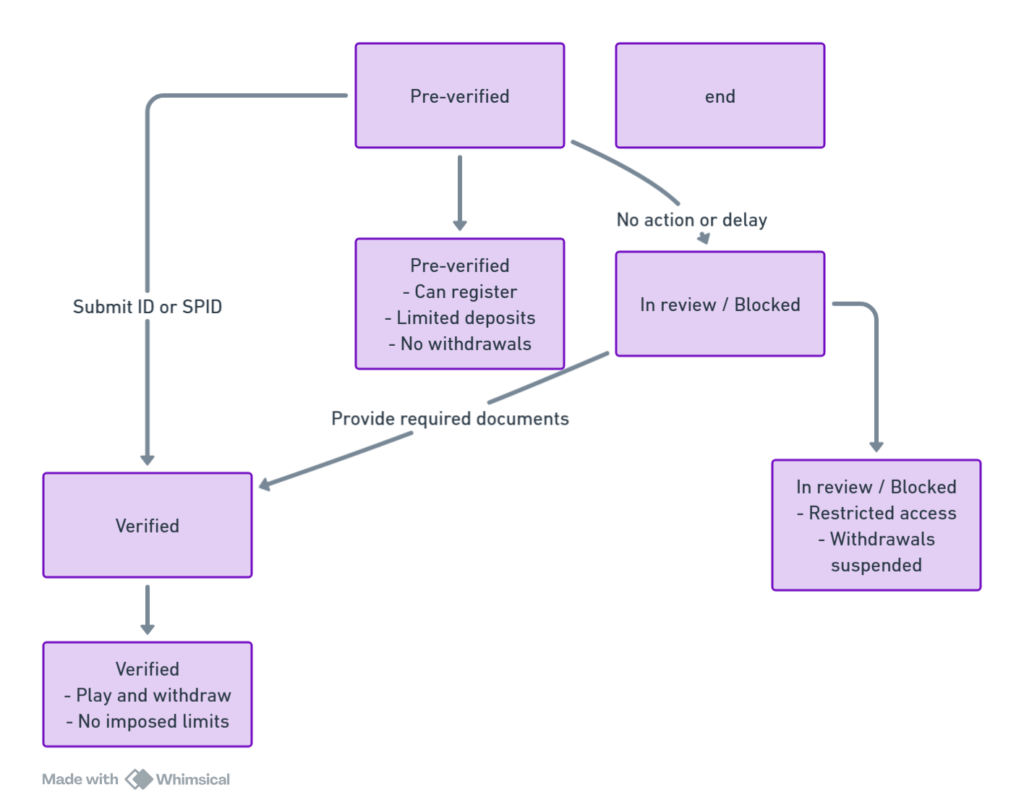
Account statuses and verification levels
Italian operators commonly classify accounts by their KYC progress:
| Account status | What you can do | Typical limits | Next step |
|---|---|---|---|
| Pre-verified | Register, deposit small amounts | Withdrawals disabled | Upload ID or complete SPID |
| Verified | Full play and withdrawal rights | Only self-imposed limits | Full access |
| In review / Blocked | Limited access | Withdrawals paused | Submit requested documents |
Certain platforms may also impose a minimum deposit – often €5 or €10 – before unlocking bonuses or specific payment methods. These thresholds tie directly into responsible gambling principles and KYC obligations.
Reforms and trends: the evolving KYC landscape
Digital identity and automation
Italy’s widespread adoption of SPID and CIE has dramatically shortened verification times. Combined with automated document checks, AI-driven image recognition, and liveness testing, the process is both safer and more efficient.
Privacy and data minimisation
The GDPR requires operators to clearly explain:
- Why each piece of data is requested;
- How long it will be stored;
- How players can exercise their rights regarding personal information.
Responsible gaming and self-exclusion
Verified identity is also what allows nationwide self-exclusion systems to work across all licensed operators. If a player chooses to self-exclude, the block is applied universally.
Impacts of KYC on players and operators
For players
- Faster onboarding thanks to digital IDs like SPID;
- Better protection from identity misuse or account theft;
- Clearer and more secure deposit/withdrawal procedures;
- A safer and more trustworthy environment on regulated platforms.
For operators
- Operational cost: verification tools, anti-fraud systems, and compliance staff represent a real investment;
- Balancing UX and security: too strict a process scares users away; too lenient increases risk;
- Reputation benefits: reputable operators such as SNAI combine smooth onboarding with full ADM compliance;
- Global brands like William Hill have also adapted to Italy’s strict rules, integrating robust AML controls without reducing user-friendliness or promotional appeal.
Comparison with other European markets
Italy’s KYC framework is considered one of the toughest in Europe, a point highlighted by Wikipedia’s overview of Gambling in Italy.
The UK, for example, emphasises affordability and age checks, while Italy prioritises digital identity verification and transaction traceability, resulting in a tightly controlled but secure environment. Leading European platforms such as Marathonbet are gradually adapting their onboarding models to align with Italy’s rigorous approach, enhancing verification technology and player protection.
Best practices for smoother verification
For players
- Keep your documents handy and ensure they’re clearly readable;
- Double-check that your personal details match your payment methods;
- Use SPID for the quickest verification;
- Be aware of minimum deposit requirements and set sensible limits.
For operators
- Offer a range of KYC options (documents, SPID, bank matching);
- Provide clear progress steps and intuitive UX;
- Apply enhanced checks only when necessary;
- Track completion rates and step-by-step bottlenecks regularly.
Case studies
Case 1 – Digital identity boosts conversion
A mid-tier operator added SPID as an alternative to manual uploads. In just three months, KYC completions climbed from 72% to 84%, with onboarding time reduced by nearly one-third.
Case 2 – Enhanced due diligence prevents fraud
A sudden attempt to withdraw a high amount to a third-party card triggered AML alerts. After requesting proof of funds, the operator uncovered inconsistencies and closed the account – demonstrating the value of strong KYC and EDD controls.
Key performance indicators
| Metric | Definition | Why it matters |
|---|---|---|
| KYC pass rate (first attempt) | % of users verified without retry | Shows how smooth the process is |
| Time to first withdrawal | Time from signup to first payout | Indicates overall efficiency |
| Enhanced due diligence cases | Share of users requiring deeper checks | Reflects risk management quality |
| Onboarding drop-off rate | % of users quitting during KYC | Highlights friction sources |
Tracking these indicators weekly helps operators quickly detect and fix weak points in their onboarding.
Conclusion: KYC as a driver of trust
In Italy, KYC has evolved from a simple formality into a cornerstone of trust – safeguarding players, ensuring operator legitimacy, and reinforcing the integrity of the regulated market. With SPID integration, stronger privacy frameworks, and ever-faster verification tools, compliance is becoming smoother and safer for everyone.
For players, understanding the process makes registration and withdrawals more predictable.
For operators, strong KYC systems and transparent onboarding build credibility – as demonstrated by major brands like SNAI, William Hill, and Marathonbet.
Ultimately, KYC is not an obstacle but the backbone of a secure and responsible Italian betting environment.