Few technologies have changed everyday payments as quickly as national instant-payment systems. India’s UPI and Brazil’s Pix turned bank transfers into something that takes seconds and works on a phone, around the clock. For online betting, which depends on moving money in and out of an account quickly, that shift raised expectations everywhere. This article looks at what UPI and Pix are, how they changed player habits, and why the legal position in each country now matters more than payment speed. It is informational and is not an invitation to bet.
Two systems, one idea
Both systems let people send money between bank accounts instantly, using a phone and a simple identifier instead of long account details. Pix is run by Brazil’s central bank and has operated since November 2020. UPI is run by the National Payments Corporation of India and has grown into one of the country’s main digital payment methods.
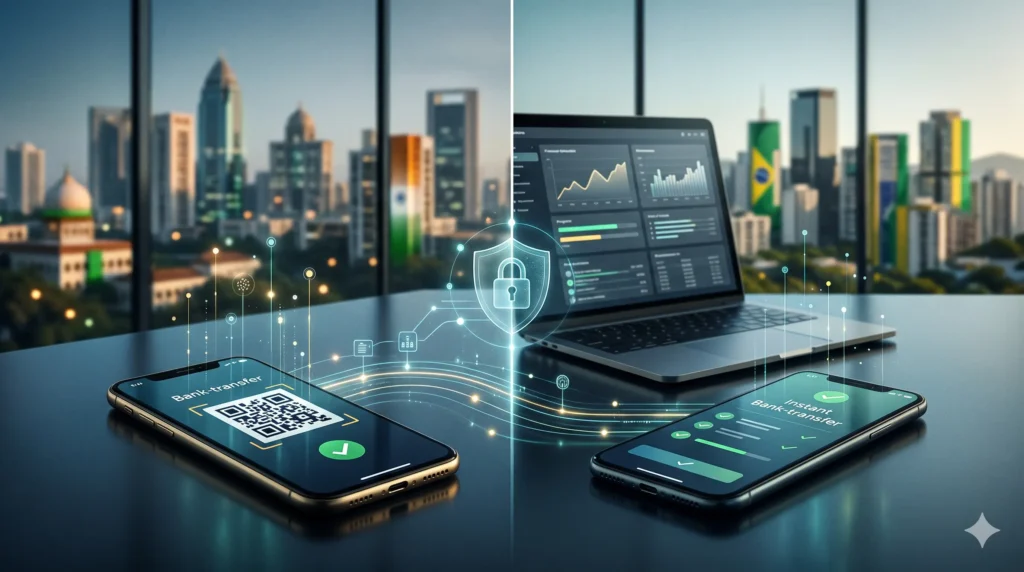
The scale is large. According to Central Banking, which cited a Banco Central do Brasil statement, Pix recorded 24 billion transactions worth 1.2 trillion reais in 2022 and set a record of 163 million transactions in a single day in December 2023.
In India, NPCI data reported by StartupTalky put UPI at 24.07 billion transactions in September 2026, with daily transactions averaging more than 800 million for the first time.
What changed for bettors
Before instant rails, deposits by card or bank transfer could take time, and withdrawals could take days. Instant systems changed that expectation. A payment that moves in seconds, with no card details typed in, became the standard that users compared every platform against.
Three changes stand out. Speed came first: bettors began to judge a platform by how quickly money arrived and left. Convenience followed, because a phone number or a QR code replaced long forms. The third was verification. Because instant payments are tied to bank accounts held in the user’s own name, identity checks became part of the process, which helps with age and anti-fraud controls.
| Feature | Before instant payments | With UPI or Pix |
|---|---|---|
| Deposit speed | Minutes to days | Seconds |
| Withdrawal speed | Often days | Depends on operator checks |
| Inputs required | Card or account details | Phone-based identifier or QR code |
| Account link | Varied | Linked to the user’s own bank account |
| Availability | Banking hours | Around the clock |
A faster payment does not mean a faster withdrawal in every case. Operators still run verification and risk checks, and those can take time regardless of the payment rail.
How operators and comparison sites responded
As UPI and Pix spread, comparison pages began to rank platforms partly on payment speed. For readers curious about how that works in the Indian market, ToffeeWeb publishes a list of the fastest sports betting sites with a UPI focus, written for Indian readers. It is a comparison of features, and the legal status described below applies to it.
Offers are another part of this picture, since many operators pair a new payment option with a sign-up promotion. ToffeeWeb’s 1xBet bonus code guide shows how one operator presents its terms to an Indian audience. Terms change often and differ by region, so the page should be read as information about that operator and not as an offer for readers elsewhere.
For a wider look at payment methods across betting markets, The Football Faithful has a guide to PayPal betting sites.
The legal picture comes first
Payment speed is only relevant where the activity is lawful. In India, The Quint reported in April 2026 that the Online Gaming Act and its 2026 Rules, in force from 1 May 2026, ban real-money online games and their advertising or facilitation. In Brazil, a provisional measure dated 25 September 2026 has been reported as banning fixed-odds betting and its advertising, and the measure is being contested, so the position may change. Readers in either country should check the current rules with official sources before using any platform.
In both cases, the payment infrastructure itself remains in everyday use for ordinary purchases. What changed is the legal treatment of the product it was being used to pay for.
What to expect next
Instant payment systems are likely to keep growing, and other countries have built or are building similar networks. For betting markets that remain lawful, the lesson is that speed, transparency and verification are now baseline expectations. For markets where the rules are changing, the legal question has to come before any comparison of payment features.
Responsible gambling
This content is for readers aged 18 and over, or the legal gambling age in their country. Gambling can be addictive. Set limits, never chase losses and do not bet money you cannot afford to lose. If you are concerned about your gambling, contact a local helpline or health service.
Frequently asked questions
What are UPI and Pix?
They are national instant-payment systems. UPI is run by India’s NPCI, and Pix is run by Brazil’s central bank.
Do instant payments make withdrawals instant?
Not always. Operators still carry out verification and risk checks, which can take longer than the payment itself.
Why are payments linked to the user’s own bank account?
It supports identity, age and anti-fraud checks.
Is online betting legal in India and Brazil?
The rules are changing. Reports say India now bans real-money online games under its 2026 Rules and that Brazil has a contested measure banning fixed-odds betting. Check official sources.
Where can I get help with gambling problems?
Contact your local helpline or health service.
For information only, not an invitation to gamble. 18+ or the legal age in your country. Gambling can be addictive. Please gamble responsibly.