Anyone who has scrolled through a UK sportsbook and then opened a Nigerian or Kenyan betting app in the same afternoon will have noticed something: the offers don’t read the same, the language is different, and even the way a “free bet” gets credited can work in an entirely different way.
That’s not an accident of branding. It comes down to regulation, payment infrastructure, currency, and what each market’s football fans actually want from a bookmaker.
This piece looks at where those differences come from and how they show up in the offers themselves — not to recommend one operator over another, but to explain the mechanics behind what punters in each region typically see.
In the UK, every operator taking bets from British customers needs a licence from the UK Gambling Commission (UKGC), and that licence comes with strict rules on how bonuses are advertised. Wagering requirements have to be disclosed clearly, “free bet” terminology is tightly policed, and misleading headline offers can result in fines.
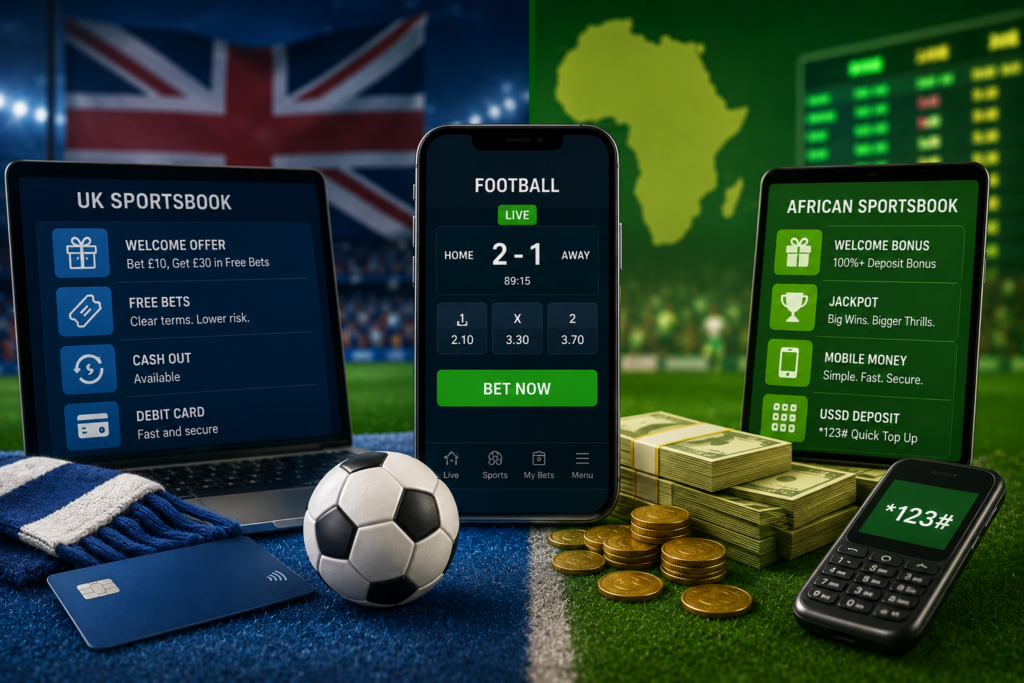
That’s part of why UK welcome offers, on the whole, look fairly conservative compared to what’s advertised elsewhere — a £10 stake for £30 in free bets is a common shape, rather than anything with a huge headline number.
Across African markets, regulation is far more fragmented. Nigeria’s National Lottery Regulatory Commission oversees lottery and gaming activity at federal level, while some states run their own licensing regimes in parallel. Kenya’s Betting Control and Licensing Board and South Africa’s National Gambling Board (alongside provincial boards) each set their own rules.
Because there isn’t a single unified regulator the way there is in Britain, advertising standards and bonus disclosure requirements vary a lot more from one licensed operator to the next.
Figures on tax treatment shift periodically, so this table should be read as a general guide rather than current legislation — always check with the relevant regulator for the latest position.
| Feature | United Kingdom | Nigeria | Kenya | South Africa |
|---|---|---|---|---|
| Primary regulator | UK Gambling Commission | National Lottery Regulatory Commission (plus state boards) | Betting Control and Licensing Board | National Gambling Board + provincial boards |
| Minimum legal age | 18 | 18 | 18 | 18 |
| Currency for stakes | GBP | NGN | KES | ZAR |
| Betting tax on winnings | None for the player | Withholding tax applies to winnings in some cases | Excise duty on stakes/winnings has applied historically | Provincial taxes vary |
| Typical KYC timing | Often required before or shortly after deposit | Frequently required at withdrawal stage | Frequently required at withdrawal stage | Varies by operator and province |
UK welcome offers tend to be modest in headline terms but transparent in structure. A typical example reads something like “bet £10, get £30 in free bets,” with clear minimum odds and a short expiry window. The Football Faithful’s guide to football betting terminology is a useful primer if any of the jargon — accumulators, odds boosts, cash-out — feels unfamiliar, since British operators lean heavily on that vocabulary in their promotions.
African markets, by contrast, often advertise much larger headline bonus percentages — a deposit match of 100% or more isn’t unusual, sometimes framed as a multiple of the player’s first deposit. These figures can look striking next to UK offers, but the wagering requirements attached to them are frequently steeper, and the free bet or bonus funds may need to be rolled over many times before any withdrawal is possible.
Punters comparing operator sign-up incentives for the Nigerian market, for instance, will find current code listings on independent pages such as Bet9ja promotional code, though as with any promotion, the value only becomes clear once the full terms are read.
| Product feature | Common in UK sportsbooks | Common in African sportsbooks |
|---|---|---|
| Cash-out | Standard on most markets | Available but less universally offered |
| Bet Builder / same-match multiples | Widely available | Growing, but not yet standard everywhere |
| Live streaming of matches | Common for major leagues | Less common; highlights or data feeds more typical |
| Multi-bet jackpot pools | Rare | Very popular, particularly for domestic and international fixtures |
| Agent or shop-based betting | Largely phased out | Still significant, especially outside major cities |
| USSD / mobile money deposits | Not applicable | Central to how many users fund accounts |
This is one of the starkest differences. UK bettors deposit mainly through debit cards, Apple Pay, or bank transfers, all tied to a formal banking relationship. In much of Nigeria, Kenya, and other African markets, mobile money and USSD codes are the default — a huge share of the population uses services like M-Pesa or bank USSD strings rather than a debit card. And sportsbooks have built their deposit flows around that reality. This isn’t a minor detail; it changes how quickly a promotion can be claimed and how withdrawal speed is perceived by users.
UK odds are usually shown in fractional format by default (5/1, 2/1), a habit going back to horse racing, though most platforms let users switch to decimal. African sportsbooks tend to display decimal odds as standard, closer to the European convention, which can make cross-market comparison slightly easier for punters who follow leagues from both regions.
Market depth also differs. English top-flight football, being the most heavily bet-on domestic league globally, gets an enormous range of markets on UK platforms — player props, corners, cards, in-play stats galore.
African operators cover the Premier League heavily too, since it remains hugely popular locally, but often pair it with strong coverage of domestic leagues, regional tournaments, and multi-match jackpot formats that aren’t really a feature of the UK market at all.
UK operators are required to display responsible gambling signposting prominently — GamStop self-exclusion, deposit limits, and links to organisations like BeGambleAware are standard on every promotional page by law.
African regulators have been introducing similar requirements, but enforcement and consistency vary by country and even by state or province. Some operators voluntarily adopt UK-style messaging as a mark of credibility, while others provide more limited signposting, which is worth keeping in mind when comparing operators across borders.
None of this is really about one market being “better” than another. UK regulation has had decades to mature, and its bonus rules reflect a market where advertising standards, problem gambling awareness, and consumer protection have been priorities for a long time.
African betting markets are younger, growing extremely fast, and adapting to a very different payments landscape and demographic — younger populations, higher mobile penetration, and in many cases, lower average deposit sizes, which pushes operators toward high-percentage headline offers rather than the flat, capped bonuses common in Britain.
Are African betting bonuses actually worth more than UK ones? Not necessarily. The headline percentage might be higher, but wagering requirements, minimum odds, and rollover conditions attached to African bonuses are often more demanding, so the real value depends entirely on the terms.
Why do UK bonuses look smaller by comparison? UK Gambling Commission rules discourage exaggerated headline offers and require clear disclosure of terms, which tends to keep advertised bonus figures more modest and predictable.
Can I use mobile money to deposit on a UK betting site? No. UK sportsbooks are built around card payments, Apple Pay, and bank transfers, since that reflects the local banking infrastructure rather than mobile money systems used elsewhere.
Is KYC verification handled the same way across both regions? Generally not. UK operators often verify identity before or shortly after a deposit, while many African operators complete verification checks at the point of withdrawal, which can occasionally delay payouts.
Do all African countries regulate betting the same way? No. Nigeria, Kenya, South Africa, and other African markets each have their own regulators and legislation, so rules on advertising, taxation, and licensing differ from country to country, unlike the UK’s single national framework.