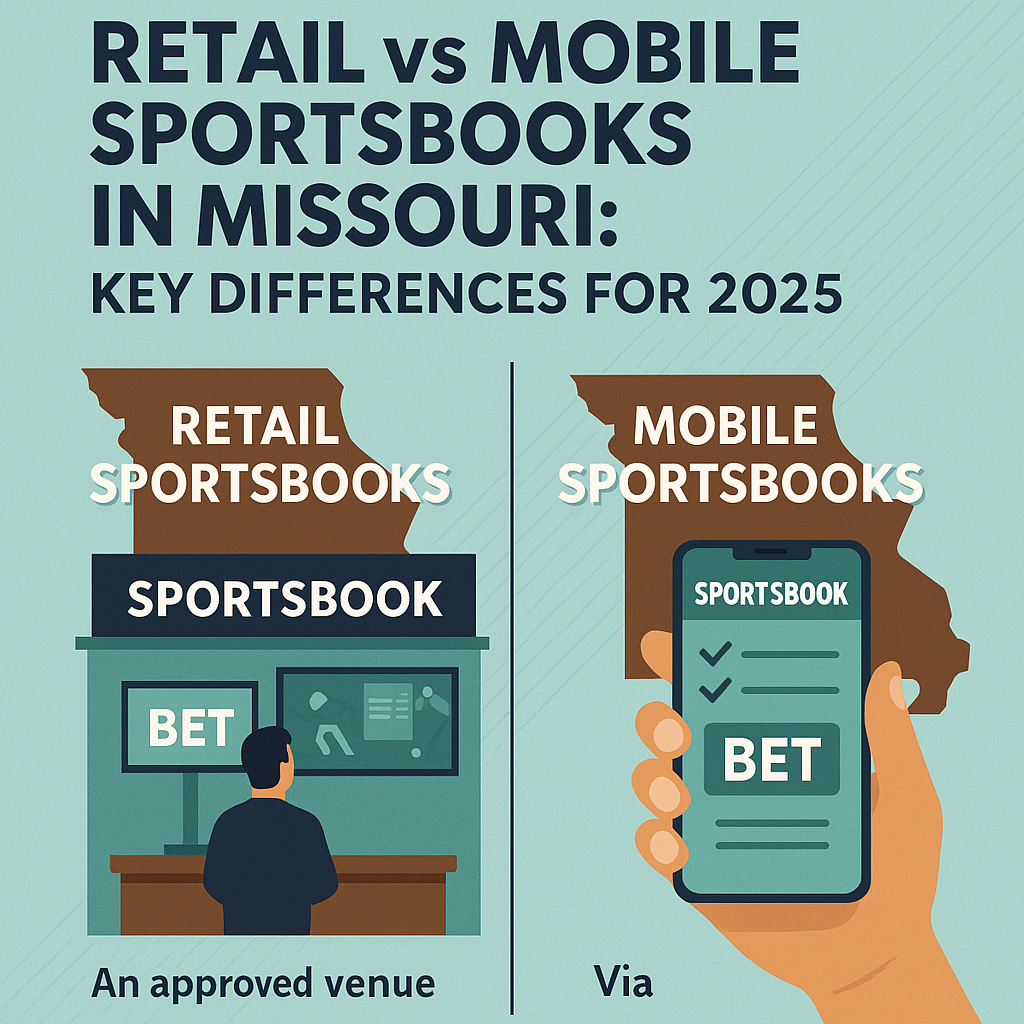
Missouri is stepping into legal sports betting with both feet in 2025. After a long, winding policy saga, the Show-Me State is scheduled to flip the switch on December 1, 2025, and it’s doing it as a dual launch: retail sportsbooks inside approved venues and mobile apps available statewide.
That sounds simple on paper. In practice, the way you bet—standing in a sportsbook lounge versus tapping your phone—changes everything: what markets you see, how bonuses work, how quickly you can react, and even the rhythm of how you watch games. This article breaks down those differences for Missouri’s first full year of legal wagering and what they mean for bettors and operators heading into 2026.
The modern era of U.S. sports betting kicked off when Murphy v. NCAA opened the door in 2018. That decision didn’t just legalise anything overnight; it handed the reins to states, and the result has been a big, messy, fascinating experiment in local models.
Since then, sports betting in the United States has expanded through a patchwork of frameworks rather than a single national rulebook. Some states leaned retail-first, some went all-in on mobile, and many (like Missouri) are now choosing a hybrid.
Across the U.S., regulation has created very different mixes of retail and app betting. Some states still limit wagering to casinos, while others are fully mobile — a split outlined in The Playoffs’ explainer on where sports betting is legal in 2025, which helps frame why Missouri’s two-track launch is such a big moment.
Missouri’s path: ballot box, not legislature
Missouri tried (and failed) for years to pass sports betting through the legislature. The breakthrough came via voters: Amendment 2, the Sports Betting Initiative, narrowly passed on November 5, 2024. The initiative is what legally locked in the December 2025 deadline for both retail and mobile wagering.
Retail and mobile operators will answer to the Missouri Gaming Commission, which sets compliance standards, licensing rules, and integrity monitoring for the new market.
The rules create a split ecosystem:
Missouri also issued two untethered mobile licenses, meaning operators that don’t need a casino partner. That move matters because it widens competition beyond casino-tethered brands and should keep lines and promos sharper from day one.
Pre-registration for mobile apps opened on November 17, 2025, allowing users to verify their identities and fund their accounts early. Actual wagering begins at 12:01 a.m. local time on December 1, 2025, for both retail and mobile.
A practical boundary at launch: in-stadium betting districts aren’t active yet, so you won’t be placing bets from your seat inside arenas on Day 1 unless rules evolve later.
Retail sportsbooks require you to be physically at a casino. There’s a real-world cost to that: travel time, a parking hunt, and the decision to make betting part of a bigger outing.
Mobile books follow you anywhere inside Missouri’s borders, enforced through geofencing.
The shift Missouri is about to experience isn’t unique. In markets like Chile, the move toward app-based wagering accelerated because people could bet instantly without travelling to a venue, a trend PrensaFutbol describes in its look at how apuestas online keep overtaking traditional storefront betting.
Mobile sportsbooks almost always offer a deeper menu because they’re not constrained by counter space or staffing. In Missouri, app users should expect:
Retail books will still carry big lines and most common props, but their menus usually lean toward high-traffic markets. If you like exploratory betting—division futures, niche props, late-night live totals—apps are built for it.
Mobile wagering keeps expanding not just because it’s convenient, but because technology keeps adding layers of live interactivity. CricXtasy’s piece on the future of online betting shows how features like real-time markets and smarter personalisation make apps feel fundamentally different from retail counters — a difference Missouri bettors will notice right away.
Even outside the U.S., mobile books are evolving faster than their retail counterparts. A good example is The Playoffs’ Italian guide to app di scommesse, which highlights how in-play tools, quick bets, and personalised dashboards are now the centre of the betting experience in most mature markets — and Missouri will likely follow that curve.
Similarly, in the UK, the best British betting sites offer incredibly useful features, attractive bets and bonuses, and a very user-friendly interface that greatly enhances the user experience.
Missouri’s pre-launch marketing wave is heavily mobile-focused. Major apps are rolling out early sign-up deals to win customers before the first legal bet is placed.
If you’re the sort who likes to browse operator differences calmly before choosing, the internal BetMGM review is a useful quick read.
You can also see how Fanduel tends to structure its Missouri launch offers and in-play tools in its dedicated breakdown.
Retail books may offer loyalty comps or smaller on-site promos, but they usually can’t match app-level bonus budgets. If you want a calm, practical way to compare what’s actually available once Missouri’s market settles, this guide to the best sportsbook Missouri gives a useful overview without the hype.
Mobile markets are more price-competitive because bettors can compare lines in seconds. That encourages tighter spreads, more frequent boosts, and faster corrections.
Retail, by nature, faces less instant comparison. The best casino books will keep pace, but mobile generally wins on pricing over time.
Ontario offers a useful preview of what happens when mobile and retail launch side-by-side. The Playoffs’ Ontario ranking of sports betting apps shows how quickly bettors gravitate toward phone play once multiple legal brands compete statewide — a pattern Missouri is very likely to repeat after December 1.
Retail sportsbooks still shine for cash betting. You can walk up, bet cash, and leave with a ticket in your pocket.
Mobile apps require digital funding:
For some bettors, that friction is fine. For others, cash matters—especially for small, spur-of-the-moment bets made while watching a game.
Both formats must follow Missouri responsible-gaming standards, including age verification (21+) and exclusion policies.
Because apps make betting frictionless, strong guardrails matter, and the National Council on Problem Gambling’s problem gambling helpline is a key resource for anyone who feels play is slipping into harm.
Mobile tends to offer more self-control features like deposit limits and time-outs right inside the app, while retail self-exclusion works more through venue processes.
| Feature | Retail Sportsbooks | Mobile Sportsbooks |
| Where you can bet | Only at licensed casinos | Anywhere in Missouri (geo-fenced) |
| Launch timing | Dec 1, 2025 | Dec 1, 2025 |
| Market depth | Moderate | High |
| Live betting | Limited compared with apps | Extensive, fast-updating |
| Promotions | Smaller, on-site perks | Large sign-ups + constant boosts |
| Payments | Cash friendly | Digital-first |
| Experience | Social, in-person | Private, ultra-convenient |
Comment: In Missouri, retail is about atmosphere; mobile is about flexibility and choice.
Retail books will attract casino regulars, tourists already in gaming districts, bettors who prefer cash, and anyone who treats betting like a night out. The in-person “watch-and-wager” feeling—especially during a Chiefs game or March Madness—remains a real draw.
Apps will probably dominate overall volume in Missouri’s first year because they fit daily life: easy to use from home, quick access to in-play lines, and big promo incentives early on.
With one of Missouri’s untethered licenses, DraftKings Sportsbook is positioned to compete statewide without relying on a casino partner.
Brands like Caesars Sportsbook are expected to lean on their casino footprints to create a smoother bridge between retail wagering and mobile accounts.
For Missouri casinos, retail sportsbooks add new foot traffic, longer visits, and partnership leverage with national app brands. Even if mobile takes most bets, retail keeps casinos central to the ecosystem.
Mobile brands reach statewide users instantly. Missouri’s untethered licensing makes the mobile field more competitive, which usually means better pricing and more variety for bettors.
Missouri’s 10% sportsbook tax isn’t just a number — it’s a policy lever meant to fund schools while still keeping the market competitive, as explained in this local Missouri sports betting tax breakdown.
When a state legalises betting, the rules don’t just open the doors — they shape how retail and mobile compete. Netflu’s breakdown of Brazil’s new lei das apostas esportivas shows how licensing and consumer-protection standards push operators toward clearer promos and safer product design, the same kind of pressure Missouri’s regulators will apply in 2025.
| Category | Missouri 2025 Rule/Status |
| Legalization method | Amendment 2 passed Nov 5, 2024 |
| Regulator | Missouri Gaming Commission |
| Go-live deadline | Dec 1, 2025 |
| Retail sites | Licensed Missouri casinos |
| Mobile betting | Statewide (geo-fenced) |
| Untethered mobile licenses | 2 (awarded 2025) |
| Tax rate | 10% of GGR |
| In-stadium betting | Not active at launch |
Comment: Missouri blends casino-based retail with a competitive statewide mobile field.
A Quick “Game Day” Comparison
Picture a Kansas City Chiefs Sunday night in December.
Retail route:
You and your friends drive to a casino, grab seats, maybe eat, and bet at a kiosk. You’re surrounded by fans sweating the same spread. The betting feels like part of a night out.
Mobile route:
You’re at home—or a bar—already registered and funded. You line-shop across apps, take a boosted line, build a same-game parlay, and drop live bets mid-drive. The experience is quicker, quieter, and more tactical.
Both are legal. One is a place, the other is a habit.
Operators are already hyping launch week on social media. Here’s a live X post from BetMGM News about its Missouri debut.
Missouri’s December 1, 2025, launch sets up a true retail-plus-mobile market, but mobile sportsbooks will almost certainly lead in volume because they’re easier, deeper, and more aggressively promoted. Retail books won’t disappear, though—they’ll stay relevant for casino traffic, cash bettors, and fans who want betting to feel like an event.
Looking ahead to 2026, expect the state to continue refining rules on venue betting districts, data integrity standards, and consumer-protection tooling as the market matures. The practical takeaway is simple: in Missouri, retail betting will be how you celebrate games, while mobile betting will be how you live with them—and having both options should make the first year of legal sports wagering lively, competitive, and bettor-friendly.